






MGO Subfloor
Categoría:
MgO Panel
Accesorios del producto:
Soluciones estándar
Strong MgO Subfloor
Size and thickness
|
Product |
Length mm |
Width mm |
Thickness mm |
|
MGO Subfloor board |
1800 |
1200 |
16/18/19/20 |
|
MGO Subfloor board |
2000 |
1200 |
16/18/19/20 |
|
MGO Subfloor board |
2440 |
1220 |
16/18/19/20 |
|
MGO Subfloor board |
2700 |
600 |
16/18/19/20 |
|
MGO Subfloor board |
3050 |
1220 |
16/18/19/20 |
Advantages
1.Stronger – 16mm MGO floor boards outperform typical 19mm Fiber Cement Floor boards and 19mm MGO floor boards outperform typical 22mm Fiber Cement floor boards.
Typical 19mm Fiber Cement floor boards have an average wet MOR (modules of rupture) of >7 MPa. 16mm MGO floor boards have a wet MOR>16 MPa. As a result, MGO floor boards can substitute thicker Fiber Cement boards while still achieving a stronger floor solution.
2.Lighter – MGO floor boards are up to 7Kg lighter than equivalent, thicker FIBER CEMENT floor boards. This results in easier handling and faster installation.
3.Cheaper – By substituting thicker FIBER CEMENT floor boards with thinner MGO floor boards, the builder can benefit from significant cost savings. Easier handling and faster installation will also reduce labor costs.
4.More Versatile – 16mm and 19mm MGO floor boards can be used internally, externally, and in wet areas. They can also be used for residential and light commercial applications. One board – multiple applications.
5.Greener Production Process – MGO floor boards have significantly less embodied energy than Fiber Cement boards.
6.Less Hazardous – Fiber Cement boards contain high levels (up to 60%) of crystalline silica (CS). When inhaled as dust particles, CS is classified as a hazardous chemical. It can lead to silicosis and/or contribute to lung cancer. MGO boards contain only trace elements of CS which do not pose a health risk.
Advantages of the Yurui MgO board
1.No 1 Automatic MgO board production machine
The high automatic degree could guarantee the accuracy of the Ratio, precise formula is the prerequisite to producing high-quality glass magnesium board
2.100% Pure Sulfate/Chloride-Free
The engineer has 25 years of experience in this field, and we have developed raw materials, formulas based on so many years of experience
3.Perfect Quality Control system
From raw material supplying, production process, goods inspections, we have established perfect quality control and tracking system
4.New product development ability
Based on so many years of production experience, we can help the client develop new products according to their market demand
Application of MgO board
The flooring MgO board is mainly used for the subflooring area.

 Packing & Loading
1)Before loading, we will screw the Green color PE strip into the pallet. This way could guarantee the whole pallet is much stronger and the pallet will not be destroyed after a long time of transportation. When customers do the unloading, sometimes the forklift destroys the PE strips. If we screw the PE strips into the wood, then this kind of problem will be avoided, which could guarantee there is no risk when the customer does the unloading.
2)If there is some space between two pallets, we will use a Dunnage bag.
3)Strong wood pallets
4)Corner Protection & film
loading is the final step for the manufacturer, we need to 100% make sure it is safe after the long-distance transportation.
SIP
SIP es un panel estructural aislado. Consisten en un núcleo de espuma rígida intercalado entre 2 revestimientos estructurales. El revestimiento más común utilizado en todo el mundo son OSB y óxido de magnesio (MgO).
El tablero de MgO ha reemplazado gradualmente a OSB como el panel SIP debido a su rendimiento superior, así como a la protección del medio ambiente, la salud, la baja emisión de carbono y otras ventajas.
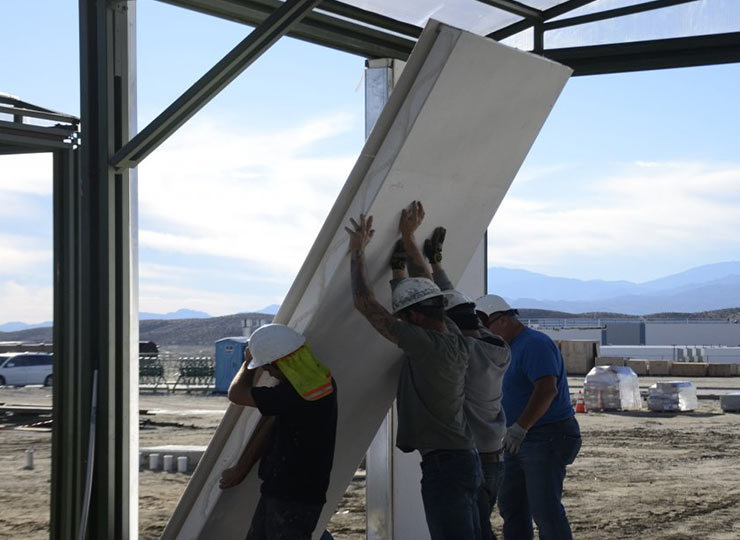

Casa modular
Las paredes interiores generalmente usan tableros de MgO con espesores que varían de 6 a 10mm, mientras que las paredes exteriores pueden requerir tableros más gruesos, como de 10 a 15mm, para proporcionar un aislamiento mejorado.
Pared de partición
Las paredes interiores y las paredes divisorias se sugieren tablas no tejidas, espesores de 6 a 12 milímetros, ya que el entorno de uso es relativamente estable, los requisitos para la junta no necesitan ser demasiado altos


Muro exterior
La pared exterior sugirió 12-15mm, o más gruesa, según el medio ambiente, como la temperatura, la humedad, el clima extremo, etc.
Personalizamos la fórmula para los clientes de acuerdo con el entorno diferente, para garantizar la vida útil del tablero.
El crítico para que el tablero del mgo sea utilizado para la pared exterior es ser impermeable.
Anterior
Siguiente
Anterior
Siguiente
Otras soluciones
Los paneles de óxido de magnesio son productos de revestimiento no aislantes fabricados en fábrica que se utilizan para aplicaciones generales de construcción. Los paneles de MgO son similares a los paneles de yeso o cemento tradicionales, pero son mucho más resistentes, ignífugos y tienen una mayor resistencia al moho, la humedad y la intemperie. El tablero de MgO se está haciendo popular en todo el mundo para su uso en paredes, como SIP, tabiques, paredes exteriores, paredes decorativas y casas modulares.
Los suelos son una de las aplicaciones más utilizadas del tablero de mgo. Las ventajas del tablero de mgo en términos de resistencia, flexibilidad, ignifugación, resistencia a la humedad, resistencia a las termitas, inocuidad para la salud, aislamiento y una huella de carbono muy baja, de sólo el 5%, hacen que se convierta rápidamente en un excelente sustituto de los materiales inmobiliarios tradicionales. La aplicación del tablero de mgo en suelos puede subdividirse en los tres tipos siguientes.
Cada año se pierden innumerables vidas en todo el mundo a causa de los incendios. Por ello, muchos países de todo el mundo elevan continuamente el nivel de seguridad contra incendios en los edificios. En la actualidad, las placas de óxido de magnesio se utilizan ampliamente en puertas cortafuegos y son muy apreciadas por su resistencia al fuego de nivel A1.

Contacte con nosotros
Camino 118, ciudad de Rushan, ciudad de Weihai, provincia de Shandong, China de Huizhou
Productos


Mensajes